Last Updated: 2026
Maintenance teams that rely on spreadsheets and memory to schedule work lose hours each week chasing details that should live in a system. Unplanned downtime eats into production targets, overtime costs climb, and assets wear out faster than they should. Maintenance scheduling software fixes this by automating preventive maintenance triggers, balancing technician workloads, and keeping every work order on track without manual follow-up.
This article breaks down how maintenance scheduling software works, what features actually move the needle on asset efficiency, and how to get it running in your operation. Whether you manage a single facility or a distributed portfolio, you will find a practical framework for replacing reactive habits with a planned, data-driven approach.
According to Deloitte, unplanned downtime costs industrial manufacturers an estimated $50 billion each year. Maintenance scheduling software exists precisely to shrink that number.
Table of Contents
- What Is Maintenance Scheduling Software?
- Why Planned Maintenance Beats Reactive Fixes
- How Maintenance Scheduling Software Works
- Key Features That Drive Asset Efficiency
- Step-by-Step: Implementing Maintenance Scheduling Software
- Common Mistakes to Avoid
- ROI: What Teams Actually Save
- Frequently Asked Questions
What Is Maintenance Scheduling Software?
Maintenance scheduling software is a digital platform that plans, assigns, and tracks maintenance work across assets and facilities. It replaces manual scheduling methods with automated triggers based on time intervals, meter readings, or condition thresholds, so preventive tasks happen when they should instead of after something breaks.
The core function is straightforward: the system knows what needs attention, when it needs it, and who should do the work. It generates work orders automatically, notifies technicians, and records completion details back to the asset record. This closed loop is what turns maintenance from a cost center into a controlled, predictable process.
Modern platforms like Keep Wisely combine scheduling with asset registries, parts inventory tracking, and reporting dashboards. The result is a single source of truth for every asset, every task, and every technician in your operation. [Internal Link: CMMS software overview]
Why Planned Maintenance Beats Reactive Fixes
Reactive maintenance feels cheaper in the moment. You fix what breaks, pay for the parts and labor, and move on. But the math does not hold up over time. Industry Week reports that reactive maintenance costs 3 to 9 times more than planned maintenance when you factor in emergency labor premiums, expedited parts shipping, production losses, and cascading damage to connected equipment.
Planned maintenance changes the equation. When you schedule work in advance, technicians arrive prepared with the right parts and instructions. Jobs take less time, assets stay online longer, and you avoid the compounding cost of unexpected failures.
Organizations that adopt preventive maintenance through scheduling software reduce downtime by up to 35%, according to Jones Lang LaSalle. The gap between reactive and planned is not marginal. It is the difference between constant firefighting and a maintenance operation that runs on its own terms.
Stat
Organizations using preventive maintenance reduce downtime by up to 35% compared to those relying on reactive approaches. (Jones Lang LaSalle)
How Maintenance Scheduling Software Works
At a high level, the software follows a repeatable cycle that turns asset data into scheduled action:
- Asset registration. You enter asset details into the system: equipment type, location, criticality rating, manufacturer specs, and warranty dates. This becomes the foundation for every schedule.
- Schedule creation. You define when each asset needs service: every 90 days, every 500 operating hours, or after a vibration sensor crosses a threshold. The software stores these rules and applies them automatically.
- Work order generation. When a trigger fires, the system creates a work order with task descriptions, estimated labor, required parts, and priority level. No manual entry needed.
- Assignment and dispatch. Available technicians receive assignments based on skill, availability, and location. Mobile notifications ensure nothing sits in an inbox waiting to be seen.
- Completion and record. Technicians log work completed, time spent, parts used, and any observations. This data flows back to the asset record and feeds future scheduling decisions.
The cycle repeats. Each pass adds more data, making subsequent schedules more accurate and helping you shift from time-based intervals toward condition-based maintenance over time. [Internal Link: preventive maintenance strategies]
Key Takeaways
- Maintenance scheduling software turns asset data into automated, repeatable work orders
- Planned maintenance cuts costs 3-9x compared to reactive approaches
- Each completed cycle adds data that improves future scheduling accuracy
Key Features That Drive Asset Efficiency
Not every feature matters equally. The capabilities listed below are the ones that directly reduce downtime, extend asset life, and give maintenance managers the visibility they need to make better decisions.
| Feature | What It Does | Efficiency Impact |
|---|---|---|
| Automated PM triggers | Generates work orders on time, meter, or condition thresholds | Eliminates missed service dates |
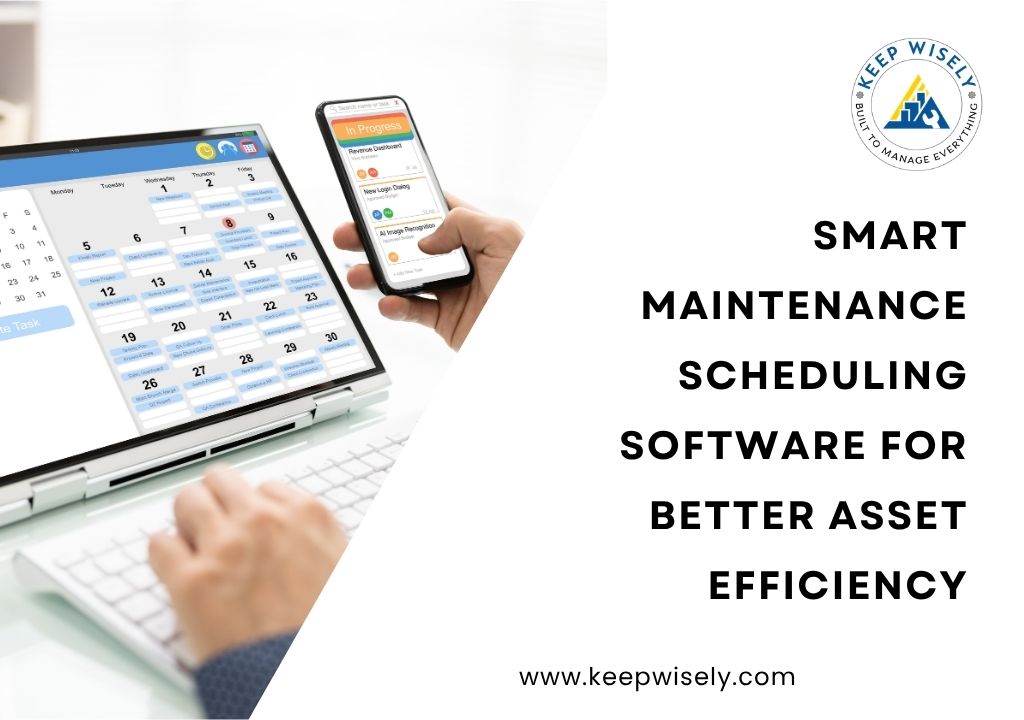
| Drag-and-drop calendar | Visual schedule view to assign and reassign work | Cuts scheduling time by hours per week |
| Mobile work orders | Technicians receive, update, and close orders on their phones | Faster completion, better data capture |
| Parts inventory linking | Connects work orders to available stock levels | Prevents delays from missing parts |
| Reporting dashboards | Tracks KPIs like PM completion rate, MTTR, and downtime cost | Enables data-backed resource decisions |
| Priority-based scheduling | Ranks work orders by asset criticality and urgency | Keeps high-impact assets running first |
Keep Wisely includes all of these features out of the box. The platform is built around the idea that scheduling should take minutes, not hours, and that every work order should connect back to a live asset record that gets smarter over time.
Pro Tip
When evaluating platforms, check whether the calendar supports multi-technician views and whether work orders automatically pull in parts availability. These two capabilities save more scheduling time than anything else combined.
Step-by-Step: Implementing Maintenance Scheduling Software
Rolling out scheduling software works best when you follow a structured process. Rushing the setup is the fastest way to end up with a system nobody trusts. Here is a practical sequence that gets results:
- Audit your asset list. Walk every facility, catalog every asset worth tracking, and record nameplate data, location, and condition. If the asset list is wrong, the schedules will be wrong too. [Internal Link: building a CMMS asset registry]
- Define maintenance triggers. For each asset, decide whether service should be calendar-based (every 90 days), meter-based (every 500 hours), or condition-based (when vibration exceeds a threshold). Start with manufacturer recommendations, then adjust based on your own failure data.
- Set priority levels. Not every asset deserves the same urgency. Rate each one by criticality: what happens if this asset fails? Production stops, safety risk, or minor inconvenience. Let the priority drive how quickly work orders get scheduled.
- Import data into the platform. Enter assets, PM schedules, parts lists, and technician profiles. Most platforms, including Keep Wisely, support CSV imports to speed this up.
- Run a parallel pilot. Keep your old scheduling method running alongside the software for 30 days. Compare results. Which approach caught more tasks? Which had fewer missed deadlines? The data makes the case for full adoption.
- Train the team and go live. Focus training on the workflows your team uses daily: viewing assignments, logging completions, flagging issues. Skip the features you will not use on day one. You can layer those in later.
Most teams complete this process in four to six weeks. The pilot period is what makes the difference. It builds confidence in the data before you fully commit.
Common Mistakes to Avoid
Even good software underperforms when implementation goes sideways. These are the pitfalls that trip up maintenance teams most often:
- Skipping the asset audit. Entering partial or outdated asset records means your schedules are built on bad data. Take the time to verify every asset before going live.
- Over-scheduling preventive tasks. Adding PM triggers for everything sounds diligent, but it creates work order bloat. Prioritize assets by criticality and failure history. Schedule what matters first.
- Ignoring mobile adoption. If technicians cannot update work orders from the field, the system loses its single-source advantage. Choose a platform with a mobile-first design.
- Setting and forgetting. Maintenance schedules are not permanent. Review them quarterly against actual failure patterns. Adjust intervals based on what the data tells you.
- Leaving leadership in the dark. Maintenance software needs executive buy-in to succeed. Share dashboard reports early and often so decision-makers see the return before they are asked to expand the investment.
Warning
The most common reason maintenance scheduling software fails is not the technology. It is skipping the upfront asset audit. Bad data in means bad schedules out. Invest the time before you go live.
ROI: What Teams Actually Save
The financial case for maintenance scheduling software is well documented. Plant Engineering reports that organizations using CMMS platforms reduce labor overtime by 20 to 30 percent, primarily because emergency call-ins drop when preventive work stays on schedule.
Facility Executive notes that structured maintenance programs extend asset lifespan by 15 to 20 percent. When you service equipment on time, it runs longer before needing replacement. That is a direct capital expense reduction.
Beyond labor and asset life, the indirect savings stack up fast. Fewer emergency orders mean less expedited shipping. Better parts forecasting means smaller safety stock. Faster work order completion means higher technician utilization. These gains compound month over month.
| Metric | Typical Improvement | Source |
|---|---|---|
| Downtime reduction | Up to 35% | Jones Lang LaSalle |
| Labor overtime savings | 20-30% | Plant Engineering |
| Asset lifespan extension | 15-20% | Facility Executive |
| Cost ratio (reactive vs. planned) | 3-9x higher for reactive | Industry Week |
Most Keep Wisely users see measurable improvements within the first quarter after implementation. [External Link: Plant Engineering CMMS benchmark report]
Key Takeaways
- Downtime drops up to 35% when preventive maintenance runs on schedule
- Labor overtime falls 20-30% as emergency call-ins decline
- Assets last 15-20% longer, reducing capital replacement costs
Frequently Asked Questions
Move from Reactive to Planned Maintenance
Maintenance scheduling software gives you three things manual processes cannot: consistency, visibility, and data. Consistency because every task fires on schedule without someone having to remember it. Visibility because you see workload, asset health, and completion rates in real time. Data because every completed work order adds to a record that makes future scheduling smarter.
The teams that benefit most are the ones that commit to the asset audit, define triggers based on actual operating conditions, and review their schedules quarterly. The software handles the mechanics. Your team provides the operational knowledge that makes those mechanics effective.
If you are ready to stop chasing breakdowns and start running a planned maintenance program, Keep Wisely gives you the scheduling tools, mobile access, and reporting to make it happen. Start your free 30-day trial at keepwisely.com and see the difference automated scheduling makes in the first month.